Presence of herpetic DNA in tissue corneal transplant
meaning and implications. Narrative review regarding a case
DOI:
https://doi.org/10.70313/2718.7446.v18.n4.457Keywords:
keratoplasty, herpes, keratitis, primary graft failure, DALKAbstract
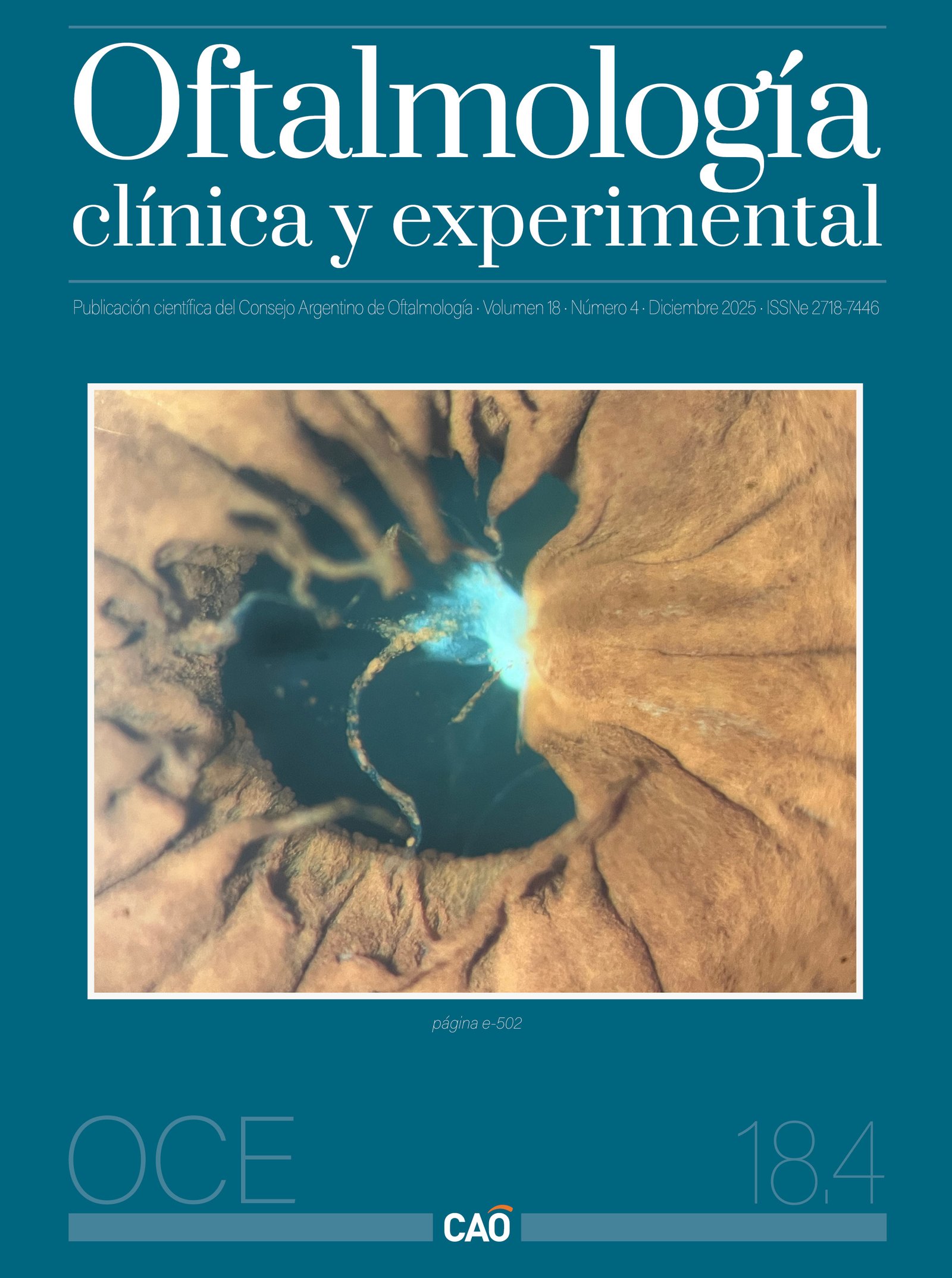
Background: Herpes simplex virus (HSV) present in a normal donor corneal button is a cause of primary failure in penetrating keratoplasties. Clinically normal corneas can carry potentially infectious herpetic genome. Recently, herpetic transmission in endothelial keratoplasties has been reported, expanding the known spectrum to different lamellar keratoplasties, especially endothelial ones. This review was motivated after analyzing a case of keratoconus, operated on with deep anterior lamellar keratoplasty (DALK) with primary failure, which, upon investigation, is identified as being caused by HSV, but without a clinical herpetic history. Corneal samples were taken for direct examination, culture, and molecular biology. Additionally, a review of the available literature was conducted. All microbiological studies were negative, except for the polymerase chain reaction (PCR) for Herpes simplex virus. The cornea regained transparency when treated for HSV. The literature review shows the occurrence of cases with primary failures of penetrating and endothelial lamellar keratoplasties due to HSV transmission in patients without herpetic history, being exceptional in anterior lamellar keratoplasties.
In summary, in any primary failure of a keratoplasty, a herpetic cause should be considered, even without prior clinical history or specific herpetic signs. The presence of herpetic DNA will allow for early diagnosis and specific antiviral treatment, with a good chance of success, and in case of graft failure, it will help protect the new keratoplasty.
Downloads
References
1. Sibley D, Larkin DFP. Update on Herpes simplex keratitis management. Eye (Lond) 2020; 34(12): 2219-2226. doi: 10.1038/s41433-020-01153-x.
2. Bhatt UK, Abdul Karim MN, Prydal JI, Maharajan SV, Fares U. Oral antivirals for preventing recurrent herpes simplex keratitis in people with corneal grafts. Cochrane Database Syst Rev 2016; 11(11): CD007824. doi: 10.1002/14651858.CD007824.pub2.
3. Biswas S, Suresh P, Bonshek RE, Corbitt G, Tullo AB, Ridgway AE. Graft failure in human donor corneas due to transmission of herpes simplex virus. Br J Ophthalmol 2000; 84(7): 701-705. doi: 10.1136/bjo.84.7.701.
4. Guerra-Assunção JA, van Kampen JJA, Roy S, Remeijer L, Breuer J, Verjans GMGM. Cluster of symptomatic graft-to-host transmission of herpes simplex virus type 1 in an endothelial keratoplasty setting. Ophthalmol Sci 2021; 1(3): 100051. doi: 10.1016/j.xops.2021.100051.
5. Guda SJM, Sontam B, Bagga B, Ranjith K, Sharma S, Joseph J. Evaluation of multiplex real-time polymerase chain reaction for the detection of herpes simplex virus-1 and 2 and varicella-zoster virus in corneal cells from normal subjects and patients with keratitis in India. Indian J Ophthalmol 2019; 67(7): 1040-1046. doi: 10.4103/ijo.IJO_1700_18.
6. Remeijer L, Doornenbal P, Geerards AJ, Rijneveld WA, Beekhuis WH. Newly acquired herpes simplex virus keratitis after penetrating keratoplasty. Ophthalmology 1997; 104(4): 648-652. doi: 10.1016/s0161-6420(97)30257-7.
7. Cockerham GC, Bijwaard K, Sheng ZM, Hidayat AA, Font RL, McLean IW. Primary graft failure: a clinicopathologic and molecular analysis. Ophthalmology 2000; 107(11): 2083-2091. doi: 10.1016/s0161-6420(00)00361-4.
8. Gatzioufas Z, Hasenfus A, Gyongyossy B, Stavridis E, Sauter M, Smola S, Seitz B. Repeat corneal graft failure due to graft-to-host herpetic infection. J Ophthalmic Inflamm Infect 2013; 3(1): 24. doi: 10.1186/1869-5760-3-24.
9. Azeem A, Baartman B, Conrady CD, Meier JL, El-Herte R. Herpes simplex virus dissemination with necrotizing hepatitis following Descemet membrane endothelial keratoplasty. BMC Infect Dis 2023; 23(1): 465. doi: 10.1186/s12879-023-08414-6.
10. Zhang S, Xiao G, Peng RM, Zhang P, Hong J. Clinical consequences of herpes simplex virus DNA in donor corneas: different prognosis and management of endothelial keratoplasty and deep anterior lamellar keratoplasty. J Clin Virol 2020; 129: 104508. doi: 10.1016/j.jcv.2020.104508.
11. Tóth G, Berkó-Göttel B, Seitz B, Langenbucher A, Stachon T, Pluzsik MT, Nagy ZZ, Smola S, Szentmáry N. Herpes simplex virus PCR in 2230 explanted corneal buttons. Acta Ophthalmol 2022; 100(1): e77-e82. doi: 10.1111/aos.14872.
12. Remeijer L, Duan R, van Dun JM, Wefers Bettink MA, Osterhaus AD, Verjans GM. Prevalence and clinical consequences of herpes simplex virus type 1 DNA in human cornea tissues. J Infect Dis 2009; 200(1): 11-19. doi: 10.1086/599329.
13. Bu JB, Grabitz SD, Pfeiffer N, Wasielica-Poslednik J. Prevalence of herpesvirus DNA in corneal transplant recipients. J Clin Med 2022; 12(1): 289. doi: 10.3390/jcm12010289.
14. Horstmann ME, Al Hariri M, Grabitz SD, Bu JB, Apel M, Pfeiffer N, Wasielica-Poslednik J. Prevalence of herpes simplex and varicella-zoster virus DNA in corneal grafts is higher than expected. Microorganisms 2023; 11(10): 2405. doi: 10.3390/microorganisms11102405.
15. Qu JH, Peng RM, Xiao GG, Qu HQ, Yu T, Zhang S, Hong J. The incidence and influence of the donor corneas positive for herpesviridae DNA in keratoplasty. Graefes Arch Clin Exp Ophthalmol 2020; 258(12): 2767-2774. doi: 10.1007/s00417-020-04984-2.
16. Qu JH, Peng RM, Xiao GG, Qu HQ, Yu T, Zhang S, Hong J. Loss of endothelial cells in viral DNA-positive grafts after keratoplasty: a 2-year follow-up study. Br J Ophthalmol 2022; 106(1): 26-31. doi: 10.1136/bjophthalmol-2020-317629.
17. Jeng YT, Tsai CY, Kuo LL, Woung LC, Lin SY, Tsai IL. The presence and impact of herpes virus DNA in recipient cornea and aqueous humor on graft survival following penetrating keratoplasty. J Formos Med Assoc 2020; 119(11): 1650-1657. doi: 10.1016/j.jfma.2019.12.009.
18. Feizi S, Azari AA. Approaches toward enhancing survival probability following deep anterior lamellar keratoplasty. Ther Adv Ophthalmol 2020; 12: 2515841420913014. doi: 10.1177/2515841420913014.
19. Abu Dail Y, Daas L, Flockerzi E, Munteanu C, Kahlert J, Smola S, Seitz B. PCR testing for herpesviruses in aqueous humor samples from patients with and without clinical corneal endothelial graft rejection. J Med Virol 2024; 96(3): e29538. doi: 10.1002/jmv.29538.
Downloads
Published
Issue
Section
License
Copyright (c) 2025 Consejo Argentino de Oftalmología

This work is licensed under a Creative Commons Attribution-NonCommercial-NoDerivatives 4.0 International License.
Con esta licencia no se permite un uso comercial de la obra original, ni la generación de obras derivadas. Las licencias Creative Commons permiten a los autores compartir y liberar sus obras en forma legal y segura.
How to Cite