ORIGINAL ARTICLES
Tomás Martín Castro, Luciano Perrone, Nazarena Nasif, Franco Perrone, Manuela Masseroni, José Russian, Diana Calero-Vera, Lucas Aguirre, Gerardo Valvecchia
Centro de Ojos Quilmes, Quilmes (Buenos Aires), Argentina.
Received: October 7th, 2025.
Approved: November 18th, 2025.
Corresponsal author
Dr. Gerardo Valvecchia
Centro de Ojos Quilmes
Humberto Primo 298
B1878KDF Quilmes, provincia de Buenos Aires
Argentina
+54 11 2206-2650
drvalvecchia@gmail.com
Oftalmol Clin Exp (ISSNe 1851-2658)
2025; 18(4): e467-e473.
DOI: https://doi.org/10.70313/2718.7446.v18.n4.466
Abstract
Purpose: To evaluate visual and refractive outcomes obtained with an intraocular lens (IOL) in a large, unselected cohort at an Argentine cataract surgery center.
Methods: This retrospective consecutive-case study included patients implanted with the TECNIS Eyhance IOL (ICB00) between November 2020 and November 2024. Postoperative evaluation was performed at one month. Recorded variables included preoperative corrected distance visual acuity (CDVA) and postoperative uncorrected distance visual acuity (UDVA) in logarithmic scale, uncorrected near visual acuity (UNVA) at 32 cm, manifest spherical equivalent (SE), implanted IOL power, and the presence of complications. Near visual acuity was measured with a Jaeger chart until March 2023 and subsequently with a standardized logarithmic chart (Byromat); Jaeger values were converted to logMAR for analysis.
Results: A total of 899 eyes from 518 patients were included. The mean implanted IOL power was 22.1 ±2.5 D. Preoperative SE averaged 1.23 ±2.3 D, decreasing to -0.42 ±0.50 D postoperatively. Preoperative CDVA was 0.16 logMAR, improving to a postoperative UDVA of 0.04 logMAR. No eye lost lines of vision. UNVA demonstrated functional performance, with most measurements between J1 and J3 during the initial phase. Using the logarithmic chart, mean UNVA at 32 cm was 0.26 ±0.11 logMAR, with most eyes between 0.2–0.3 logMAR.
Conclusion: The Eyhance IOL provided reliable uncorrected distance and functional near visual outcomes, with a favorable safety profile throughout the four-year study period.
Keywords: intraocular lenses, cataract surgery, Eyhance, functional vision.
Resultados del mundo real de la lente intraocular TECNIS Eyhance: evidencia de un estudio retrospectivo de alto volumen en la Argentina
Resumen
Objetivo: Evaluar resultados visuales y refractivos obtenidos con una lente intraocular en una cohorte amplia y no seleccionada en un centro argentino de cirugía de cataratas.
Métodos: Estudio retrospectivo de casos consecutivos que incluyó pacientes implantados con la lente TECNIS Eyhance (ICB00) entre noviembre de 2020 y noviembre de 2024. La evaluación postoperatoria se realizó al mes. Se registraron la agudeza visual de lejos preoperatoria (AVL) con corrección (c/c) y postoperatoria sin corrección (s/c) en escala logarítmica, la agudeza visual cercana sin corrección (AVC s/c) a 32 cm, el equivalente esférico (EE) manifiesto, el poder dióptrico implantado y la presencia de complicaciones. La AVC se midió con cartilla Jaeger hasta marzo de 2023 y luego con una cartilla estandarizada en escala logarítmica (Byromat); los valores Jaeger fueron convertidos a logMAR para su análisis.
Resultados: Se incluyeron 899 ojos de 518 pacientes. El poder dióptrico medio implantado fue de 22,1 ±2,5 D. El EE preoperatorio fue de +1,23 ± 2,3 D, disminuyendo a -0,42 ±0,50. La AVL c/c preoperatoria fue de 0,16 logMAR, mejorando a una AVL s/c de 0,04 logMAR. Ningún ojo perdió líneas de visión. La AVC s/c mostró un desempeño funcional con predominio de valores entre J1 y J3 en la etapa inicial. Con la cartilla logarítmica, la AVC s/c media fue de 0,26 ± 0,11 logMAR (mayoría entre 0,2-0,3 logMAR).
Conclusión: La lente Eyhance brindó resultados confiables de visión lejana y cercana funcional sin corrección con un perfil de seguridad favorable a lo largo de cuatro años.
Palabras clave: lentes intraoculares, cirugía de cataratas, Eyhance, visión funcional.
Resultados no mundo real da lente intraocular TECNIS Eyhance: evidências de um estudo retrospectivo de grande volume na Argentina
Resumo
Objetivo: Avaliar os resultados visuais e refrativos obtidos com uma lente intraocular em uma grande coorte não selecionada em um centro de cirurgia de catarata na Argentina.
Métodos: Estudo retrospectivo de casos consecutivos incluiu pacientes com implante da lente TECNIS Eyhance (ICB00) entre novembro de 2020 e novembro de 2024. A avaliação pós-operatória foi realizada um mês após a cirurgia. Foram registrados a acuidade visual à distância (AVD) pré-operatória com correção (c/c) e a acuidade visual sem correção (s/c) pós-operatória em escala logarítmica, a acuidade visual para perto sem correção (s/c) a 32 cm, o equivalente esférico manifesto (EE), o poder dióptrico implantado e a presença de complicações. A s/c foi medida utilizando a tabela de Jaeger até março de 2023 e, posteriormente, com uma tabela padronizada em escala logarítmica (Byromat); os valores de Jaeger foram convertidos para logMAR para análise.
Resultados: Foram incluídos 899 olhos de 518 pacientes. A potência dióptrica média implantada foi de 22,1 ± 2,5 D. O erro refrativo (ER) pré-operatório foi de +1,23 ± 2,3 D, diminuindo para -0,42 ± 0,50 D. A acuidade visual de perto (AVP) pré-operatória foi de 0,16 logMAR, melhorando para uma AVP sem visão (AVSC) de 0,04 logMAR. Nenhum olho apresentou perda de linhas de visão. A AVSC demonstrou desempenho funcional com valores predominantemente J1-J3 na fase inicial. Com a tabela logarítmica, a AVSC média foi de 0,26 ± 0,11 logMAR (principalmente entre 0,2 e 0,3 logMAR).
Conclusão: A lente Eyhance proporcionou resultados confiáveis para acuidade visual de longe e de perto sem correção, com um perfil de segurança favorável ao longo de quatro anos.
Palavras-chave: lentes intraoculares, cirurgia de catarata, Eyhance, visão funcional.
Introduction
Cataract surgery has evolved into a refractive procedure in which patient expectations extend beyond distance vision, increasingly demanding functional performance at intermediate and near ranges1-5. Traditional monofocal intraocular lenses (IOLs) provide excellent uncorrected distance visual acuity but offer limited depth of focus, often requiring patients to rely on spectacles for daily intermediate tasks such as computer work or viewing digital devices4. To bridge the gap between monofocal and multifocal technologies, a new category of “enhanced monofocal” or “monofocal-plus” IOLs has emerged1, 4.
The TECNIS Eyhance™, model ICB00 (Johnson & Johnson Surgical Vision, Inc., Santa Ana, CA, USA) represents one of the most widely adopted lenses in this category6-8. Its unique higher-order aspheric anterior surface is designed to extend depth of focus while maintaining the optical simplicity of a monofocal design and minimizing the risk of dysphotopsias typically associated with multifocal or diffractive technologies6, 9. Early clinical studies have shown improved intermediate vision and high spectacle independence for everyday tasks, yet many of these reports stem from controlled environments or relatively small cohorts6-10.
Given the rapid and widespread incorporation of Eyhance into routine cataract surgery, real-world evidence from large, unselected populations remains essential to confirm its performance outside of controlled clinical trials. This study aimed to evaluate the visual, refractive, and near-vision outcomes of the TECNIS Eyhance IOL in a high-volume, real-world cohort from a single Argentine center.
Methods
Study design and ethical considerations
This retrospective, consecutive-case study included medical records of patients who underwent cataract surgery with implantation of the TECNIS Eyhance IOL (ICB00) at Centro de Ojos Quilmes between November 2020 and November 2024. All data were extracted from electronic health records and anonymized before analysis. The study protocol was reviewed and approved by the Ethics Committee of Centro de Ojos Quilmes and conducted in accordance with the Declaration of Helsinki. All patients had previously provided written informed consent allowing the use of their clinical data for academic and research purposes.
Study population and eligibility
Eligible cases included eyes that completed postoperative follow-up and clinical discharge at one month (30 days ± 5 days). Recorded variables included demographic data (age and sex), implanted IOL power, best-corrected preoperative distance visual acuity, uncorrected postoperative distance visual acuity, preoperative and one-month postoperative spherical equivalent, uncorrected near visual acuity at 32 cm assessed using a logarithmic chart (with complementary Jaeger notation), and any intraoperative or postoperative complications.
Eyes were excluded if they presented corneal disease (keratoconus, leucoma, or corneal dystrophies), macular pathology (diabetic macular edema, epiretinal membrane, macular hole, or clinically significant diabetic or hypertensive retinopathy), a history of refractive surgery, preoperative corneal astigmatism >0.75 D, or any condition capable of limiting postoperative visual potential. Both eyes from bilateral cases were included when each eye independently met eligibility criteria.
Surgical technique
All surgeries were performed using the phacoemulsification technique with direct (horizontal) chopping. Clear corneal incisions, continuous curvilinear capsulorhexis, and conventional nucleus removal (divide-and-conquer or stop-and-chop) were performed according to surgeon preference. The TECNIS Eyhance IOL (ICB00) was implanted in the capsular bag using a preloaded injector system. Surgical outcomes reflect the combined experience of four surgeons operating under standardized institutional protocols at Centro de Ojos Quilmes.
Outcome measures
The primary outcomes were uncorrected distance visual acuity (UDVA) compared with preoperative corrected distance visual acuity (CDVA), and the manifest spherical equivalent (SE) before and after surgery. Distance visual acuity was originally recorded using a decimal scale, and all values were subsequently converted to logMAR for statistical analysis, allowing linear comparisons and standardized reporting. Secondary outcomes included uncorrected near visual acuity (UNVA) at 32 cm measured with a logarithmic chart (complemented by Jaeger notation), the presence of intraoperative or postoperative complications, and the dioptric power of the implanted intraocular lens. All outcomes were analyzed per eye. Near visual acuity was assessed using two methods over the course of the study due to an institutional update in measurement protocols. Until March 2023, near vision was recorded using the Jaeger scale. From that date onward, UNVA at 32 cm was evaluated with a standardized logarithmic reading chart (Byromat). To ensure comparability across the entire dataset, all Jaeger values were converted to their corresponding logarithmic equivalents using a validated correlation procedure, allowing the full near-vision analysis to be expressed uniformly in logMAR units.
Statistical analysis
Data normality was assessed using the Shapiro-Wilk test. Continuous variables were analyzed using paired t-tests or Wilcoxon signed-rank tests, depending on distribution. Categorical variables, including complication rates and refractive predictability (percentage of eyes within ±0.50 D and ±1.00 D of the intended correction), were evaluated using chi-square or Fisher’s exact tests when appropriate. Results are reported as mean ± standard deviation (SD), unless otherwise specified. A p-value < 0.05 was considered statistically significant. Statistical analyses were performed using XLMiner Analysis ToolPak.
Results
A total of 899 eyes from 518 patients were included in the analysis. The mean age was 65.3 ± 9.2 years (range, 43-87), with 277 women and 241 men. The implanted intraocular lens (IOL) power averaged 22.1 ± 2.5 D (range, 10.0-31.0 D). Preoperative spherical equivalent showed wide variability across the cohort, with a mean of +1.23 ± 2.3 D (-16.00 to +8.25 D). At one month postoperatively, refraction shifted markedly toward emmetropia, with a mean spherical equivalent of -0.42 ± 0.50 D (-2.75 to +1.00 D). Distance visual acuity improved consistently across eyes. Preoperative corrected distance visual acuity averaged 0.16 ± 0.12 logMAR (0.00-1.00), whereas postoperative uncorrected distance visual acuity reached 0.04 ± 0.05 logMAR (0.00-0.22). No eye experienced a loss of visual acuity lines during follow-up.
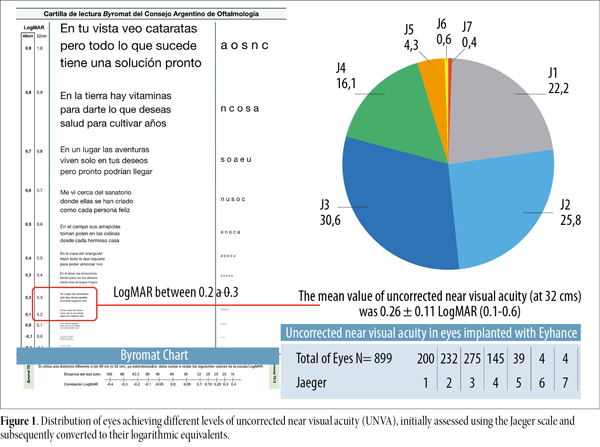
Near visual acuity was assessed using two different systems during the study period. In the initial phase, near vision was recorded using the Jaeger chart. Among these eyes, most achieved values between J1 and J3, with decreasing numbers in more reduced categories. This distribution is illustrated in Figure 1, which also includes the correlation between Jaeger notation and the Byromat reading chart logarithmic scale. Following the institutional transition to the logarithmic reading chart, the mean uncorrected near visual acuity at 32 cm was 0.26 ± 0.11 logMAR (range, 0.1-0.6), with the majority of eyes clustering between 0.2 and 0.3 logMAR. Jaeger measurements obtained before March 2023 were subsequently converted to their corresponding logMAR values to allow uniform analysis of near visual performance across the full cohort.
Discussion
The present study provides real-world evidence on the visual and refractive performance of the TECNIS Eyhance IOL in a large, unselected cohort from an Argentine high-volume cataract center. Unlike prospective trials with strict follow-up schedules, this analysis reflects routine clinical practice, in which postoperative evaluation typically occurs at one month, the time point when patients are clinically discharged. In a referral-based practice such as ours, many patients subsequently continue follow-up with their local ophthalmologists, making the one-month visit the most consistent and reliable moment for standardized data collection.
The variables analyzed, uncorrected distance visual acuity, uncorrected near visual acuity at 32 cm, refractive status, and the presence of complications, represent the parameters most relevant in everyday clinical decision-making to determine functional outcomes and suitability for discharge. In this pragmatic context, more sophisticated assessments such as defocus curves, contrast sensitivity testing, or structured dysphotopsia questionnaires were not routinely obtained, reflecting the workflow of a high-volume cataract service rather than a controlled research environment. Despite these limitations, the large sample size offers robust insight into real-world visual performance with the Eyhance IOL.
The results observed in our cohort confirm the functional performance expected from Eyhance, with excellent uncorrected distance visual acuity, a useful level of near vision, and a favorable safety profile. These findings are consistent with previously published data6-8 and help validate what patients frequently report subjectively: that they “see well” after implantation, especially in standard daily-life visual tasks.
It is also important to interpret these findings within the context of current technological evolution. Newer enhanced monofocal and non-diffractive extended-depth-of-focus IOLs, such as the Puresee lens, have recently gained clinical attention and, in many centers, appear to be progressively replacing Eyhance as the preferred option in this category11-14. However, Puresee was not available during the period of our study, and we do not have comparative or direct performance data from our own patient population. Its mention here serves only to frame the present results within the rapidly changing landscape of cataract surgery technologies.
Finally, the extensive use of Eyhance in our setting, reflected in the large number of cases, also relates to its availability, optical simplicity, and cost-effectiveness, factors that made it a widely adopted solution during the years covered by this study. Our results, therefore provide meaningful real-world validation of its performance before the emergence of newer platforms such as Puresee.
Conclusion
In this large real-world cohort, the TECNIS Eyhance IOL demonstrated reliable visual performance, with excellent uncorrected distance visual acuity, functionally useful near vision, and a favorable safety profile at one month after surgery. The findings reflect the outcomes obtained in a high-volume ophthalmic practice. Although newer enhanced monofocal and non-diffractive EDOF platforms have since emerged, these results provide meaningful validation of the Eyhance IOL during the period in which it was widely adopted in our setting.
References
LEYENDAS
Figure 1. Distribution of eyes achieving different levels of uncorrected near visual acuity (UNVA), initially assessed using the Jaeger scale and subsequently converted to their logarithmic equivalents.