ORIGINAL ARTICLES
Gabriel Martina, Abel Szepsb-c, Guillermo Saraccod, Martin de Tomasa, Rafael Iribarrena, e
a Novar, Miami, USA.
b Ophthalmology Department, National Hospital Posadas, El Palomar (Buenos Aires), Argentina.
c + Ophthalmology, Buenos Aires, Argentina.
d Saracco Optical Center, Buenos Aires, Argentina.
e Drs. Iribarren Eye Consultants, Buenos Aires, Argentina.
Received: September 4th, 2025.
Approved: October 5th, 2025.
Corresponsal author
Dr. Rafael Iribarren
Arenales 981
(1061) Buenos Aires, Argentina
Tel +54-911-5147-9312
rafairibarren@gmail.com
Oftalmol Clin Exp (ISSNe 1851-2658)
2025; 18(4): e434-e442.
DOI: https://doi.org/10.70313/2718.7446.v18.n4.455
Funding
Not applicable.
Declaration
This submission has not been published anywhere previously and it is not simultaneously being considered for any other publication.
Conflict of interest
Martin de Tomás, Gabriel Martín and Rafael Iribarren report personal fees from NOVAR and Opulens related to the submitted work. The Fresnel Myofix device for myopia control is registered with patent Nº WO2024/163955 A1.
Abstract
Purpose: This study explores choroidal thickness increments while reading with a device based on an adaptation of Myofix peripheral defocus spectacle design for myopia control.
Methods: A series of voluntary myopic young subjects were tested for 20 minutes reading a book on computer display with their usual correction and for another 20 minutes reading with Myofix spectacles constructed with a plus 3.5 diopters add Fresnel lens. The Fresnel lens was carved with a central 9 mm hole for distance vision through the usual correction and was adapted in a plano 37 mm diameter lens probe. Usual correction with the Fresnel lens was fitted in trial frames. The axial length was measured at baseline and after each period of reading.
Results: For this study, 16 subjects of both genders (4 females) were tested with Myofix Fresnel lenses. Their mean age was 22.51+/-5.78 years. Their mean spherical equivalent of the right eye was -2.48+/-0.96 diopters. There was a non-significant increase of +1.55 microns in axial length from baseline when reading with the usual prescription (p=0.561). When subjects read in the same situation with Myofix Fresnel defocus spectacles for other 20 minutes, axial length decreased by -8.22 microns (p=0.002).
Conclusions: The Myofix design applied in a Fresnel lens with the usual correction produces axial length shortening in a similar manner as the polycarbonate carved lens. This short term axial length shortening is in line with an effect in arresting myopia progression as has been demonstrated in the Myofix trial.
Keywords: Fresnel lens, myopia control.
Cambios en la longitud axial con gafas Fresnel de desenfoque periférico para el control de la miopía: el estudio Myofix
Resumen
Objetivo: Evaluar el aumento del grosor coroideo durante la lectura con un dispositivo basado en una adaptación del diseño de gafas de desenfoque periférico Myofix para el control de la miopía.
Métodos: Se realizó una serie de pruebas a jóvenes miopes voluntarios durante 20 minutos leyendo un texto en la pantalla de un ordenador con su corrección habitual y durante otros 20 minutos leyendo con gafas Myofix fabricadas con lentes Fresnel de +3,5 dioptrías. La lente Fresnel se talló con un orificio central de 9 mm para la visión de lejos a través de la corrección habitual y se adaptó a un probín de lente plano de 37 mm de diámetro. La corrección habitual más la lente Fresnel se colocó en la montura de prueba. La longitud axial se midió al inicio del estudio y después de cada período de lectura.
Resultados: Para este estudio se evaluaron 16 sujetos (4 mujeres) con lentes Fresnel Myofix. La edad media fue de 22,51 ± 5,78 años. El equivalente esférico medio del ojo derecho fue de -2,48 ± 0,96 dioptrías. Se observó un aumento no significativo de +1,55 micras en la longitud axial con respecto del valor inicial al leer con la prescripción habitual (p = 0,561). Cuando los sujetos leyeron en la misma situación con gafas de desenfoque Fresnel Myofix durante otros 20 minutos, la longitud axial disminuyó en -8,22 micras (p = 0,002).
Conclusiones: El diseño Myofix aplicado en una lente Fresnel con la corrección habitual produce un acortamiento de la longitud axial de manera similar a la lente tallada en acrílico. Este acortamiento a corto plazo está en consonancia con el efecto de detener la progresión de la miopía, tal y como se ha demostrado en el ensayo Myofix.
Palabras clave: lentes de Fresnel, control de la miopía, largo axial.
Alterações no comprimento axial com óculos de Fresnel de desfocagem periférica para controle da miopia: o estudo Myofix
Resumo
Objetivo: Avaliar o aumento da espessura da coroide durante a leitura com um dispositivo baseado em uma adaptação do design dos óculos de desfocagem periférica Myofix para controle da miopia.
Métodos: Uma série de testes foi realizada em jovens voluntários míopes. Os participantes tiveram 20 minutos para ler um texto na tela do computador com sua correção habitual e outros 20 minutos para ler com óculos Myofix confeccionados com lentes de Fresnel de +3,5 dioptrias. A lente de Fresnel foi lapidada com um orifício central de 9 mm para visão de longe com a correção habitual e adaptada a uma sonda plana de 37 mm de diâmetro. A correção habitual, juntamente com a lente de Fresnel, foi colocada na armação de teste. O comprimento axial foi medido no início do estudo e após cada período de leitura.
Resultados: Dezesseis indivíduos (4 mulheres) foram avaliados neste estudo utilizando lentes de Fresnel Myofix. A idade média foi de 22,51 ± 5,78 anos. O equivalente esférico médio do olho direito foi de -2,48 ± 0,96 dioptrias. Observou-se um aumento não significativo de +1,55 micrômetros no comprimento axial em comparação com o valor basal durante a leitura com a prescrição usual (p = 0,561). Quando os indivíduos leram nas mesmas condições utilizando óculos de desfocagem de Fresnel Myofix por mais 20 minutos, o comprimento axial diminuiu em -8,22 micrômetros (p = 0,002).
Conclusões: O design Myofix aplicado a uma lente de Fresnel com correção padrão produz um encurtamento do comprimento axial semelhante ao de uma lente de acrílico esculpida. Esse encurtamento a curto prazo é consistente com o efeito de interromper a progressão da miopia, conforme demonstrado no estudo Myofix.
Palavras-chave: lentes de Fresnel, controle da miopia, comprimento axial.
Introduction
Myopia in children can now be effectively managed through a range of treatment options, including modifications in lifestyle and visual environment, pharmacological therapies, and optical devices1. Early treatment is essential, as both the onset and progression of myopia are modifiable factors that, if left untreated, increase the risk of developing serious ocular complications later in life2-3.
Key modifiable myopigenic lifestyle factors include time spent outdoors and engagement in near work activities indoors, such as reading and using electronic devices4. Although time spent reading has been associated with the development of myopia5, reading is a fundamental part of daily life for both children and adults, whether for education, work, or leisure. The contribution of indoor lighting conditions in combination with near work to myopia development, however, remains not fully understood6-7.
Medical treatments include oral medications like methylxantine, ocular drops of diluted atropine in varying concentrations and medical devices that stimulate the retina with blue or red light8-9. Optical treatments include peripheral defocus or low contrast spectacles of different types, plus similar peripheral plus add defocused contact lenses and orthokeratology10. All these types of treatments are innovative and should be tested in real-life settings once the clinical trials involved in them are completed. The medical community will then evaluate in each treatment, or their combinations, the cost effectiveness of any tailored specific approach11-12.
This study comprises a device based on an adaptation of a peripheral defocus spectacle designed by our group in Argentina, the Myofix myopia control lens13, which has been tested in a one year clinical trial since 202314. This spectacle was originally tested for its effect on modifying choroidal thickness during short reading periods in young individuals15. The first experiments showed that reading for 40 minutes under 120 lux room illumination caused the choroid to thicken (according to movements in axial length measured with the Lenstar), and thus, a clinical trial was commenced14-15. This last trial finished in April 2025 after following 36 subjects who wore the spectacle for one year, and it has shown good results in controlling myopia progression up to 75% effectiveness.
The devices used in the present study share the same design as the Myofix spectacle, but have been constructed with +3.50 diopters Fresnel lenses adapted to each subject’s myopic correction in trial frames for reading tests. In the case of this experiment the luminance of the testing room was slightly increased for studying the effect illumination when testing choroidal movements indirectly with biometry.
Material and methods
An experimental set up study was designed. The study was conducted in accordance with the tenets of the Helsinki Declaration and the Ethics Committee of the Argentinian Council of Ophthalmology approved the study. The present study —as previous ones7, 15— tooks place in the City of Buenos Aires, Argentina. Previous assessment of choroidal movements with Myofix spectacles were conducted in Szeps’ lab in Liniers Ophthalmological Centre, under an illumination level of 120 lux at the subjects’ testing desk15. In that case, subjects read black text on a computer screen for two periods of 40-minutes periods, first with their habitual myopia spectacles and then with Myofix defocus spectacles. That study showed that axial length, measured with the Lenstar device as the average of five measurements, increased while reading with habitual spectacles (+8.1 µm) and subsequently shortened after reading with Myofix defocus spectacles during the second period (-10.6 µm)15. Another set of experiments were done in Saracco’s lab, in the city of Buenos Aires, under mesopic light conditions, showing that the same device did not elicit axial length shortening when reading in a dim light environment7.
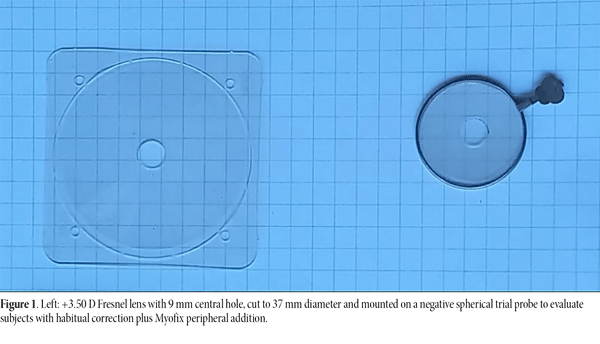
In this study, Fresnel plastic lenses of +3.50 diopters (Fresnel Technologies Inc., Texas, USA) were cut into circular shapes with a 37 mm diameter, including a 9 mm diameter central hole at the center of the Fresnel lens. These Fresnel lenses were then applied to the probes for testing myopic subjects with their habitual correction (Fig. 1). In the initial reading period, subjects viewed black text on a computer screen, as in previous studies15-16, while wearing their habitual correction. In the subsequent period, the probes fitted with the Fresnel peripheral plus add were employed. In the current experiments, reading periods were reduced compared to previous studies, consisting of 20 minutes with habitual correction and 20 minutes wearing Myofix Fresnel lenses. First, subjects remained in the testing room for 15 minutes, engaging in casual conversation with the research team to allow for adaptation to indoor luminance. These experiments were also conducted at Saracco’s Lab (Buenos Aires, Argentina).
After the adaptation period, axial length was measured at three time points: baseline, 20 minutes, and 40 minutes. Each measurement period lasted 2-4 minutes and was performed using the MYAH biometer (Topcon, USA), acquiring four measurements from the right eye and averaging them to three decimal places (up to one micron). The testing room was fully illuminated, with an average of 250 lux at the testing desk. Subjects read a similar black text with white background, with same angular size, at 70 cm from the computer screen as was done in previous experiments with Myofix defocus spectacles.
Subjects, as usual, were instructed to rest well before the morning of the testing day, which was scheduled on Saturdays, from 9.00 a.m. to 11.00 a.m., to avoid problems with school, university or working hours. The testing schedule was set for the morning hours, as circadian choroidal fluctuations remain relatively stable during this period, prior to reaching their peak in the afternoon. Subjects were also instructed to have a light breakfast when getting awake and were not allowed to drink during the hour that the testing lasted. Myopic subjects were volunteers attending our office who were informed about the testing procedures and accepted willingly to participate in the study of a myopia control device. Subjects gave verbal informed consent to participate in the study. The study was conducted in accordance with the tenets of the Helsinki Declaration and the Ethics Committee of the Argentinian Council of Ophthalmology approved the study. Refractive error was obtained from the records of the patients. Only low and moderate myopes age 15 to 30 years old were included, with no ocular disease except their myopia. For testing with the Myofix Fresnel lens in the testing probes, the probes were centred in an Oculus half eye trial frame (Oculus Inc., USA).
Using sample size calculations for a difference of 0.003 mm between pre- and post-test measurements, with a variance of 0.002 mm, significance (p) value less than 0.05, and statistical power of 95%, it was estimated that 15 participants would be sufficient15. For the statistical analysis the data were gathered in an excel table were means and standart deviations were calculated. Student t test were performed with the distribution of variables for baseline, first and second periods in each subject’s right eyes and the differences up to 1 micron between pre- and post-spectacle use were calculated. As the axial length distributions were normal, according to the Kolmogorov-Smirnov test, and had similar variances, parametric statistics were applied. A p value < 0.05 was considered significant.
Results
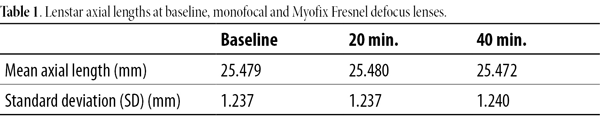
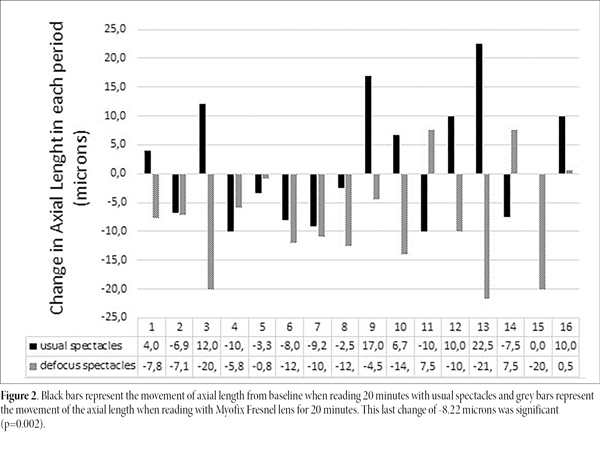
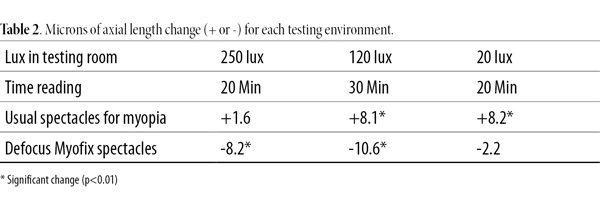
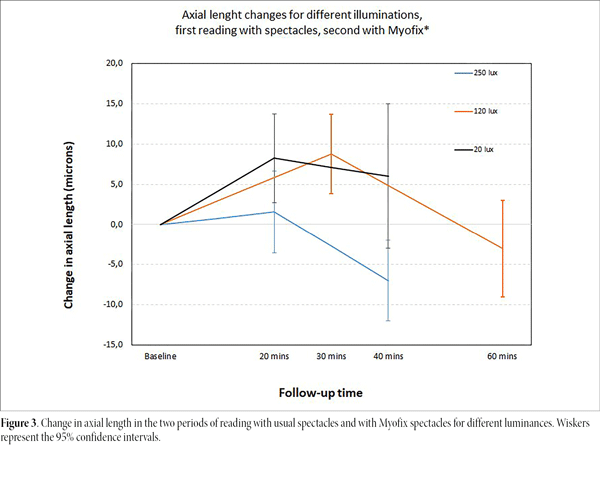
For this study, 16 subjects of both genders (4 females) were tested with Myofix Fresnel lenses. Their mean age was 22.51+/-5.78 years. Their mean spherical equivalent of the right eye was -2.48+/-0.96 diopters. The mean axial lengths at baseline (after 15 minutes light adaptation), after usual spectacles (20 min more), and after special defocus spectacles (other 20 min more) are shown in Table 1. There was a non-significant increase of +1.55 microns in axial length from baseline when reading with the usual prescription (p=0.561). When subjects read in the same situation with Myofix Fresnel defocus spectacles for other 20 minutes, axial length decreased by -8.22 microns (p=0.002). Figure 2 shows the actual measured values for each subject. Table 2 and Figure 3 show the main results in microns of change in axial length with the three illuminations. There is a lack of axial elongation while reading with usual spectacles in 250 lux, and there is a lack of axial shortening when reading with defocus spectacles in 20 lux.
Discussion
This new study with measurement of biometric changes in axial length shows that the eyes again become shorter when reading for 20 minutes black text with full view +3.50 peripheral defocus in front of the myopic correction lenses. This is in line with a possible increase in choroidal thickness that would be a signal in myopic eyes for arresting myopia progression via decreased ocular growth17. The Myofix trial with the same defocus spectacles has recently showed good results in arresting myopia progression in children after 12 months of follow up, with both good adaptation and compliance (12 month follow up in preparation)14. So it is expected that this Fresnel lens design would have similar results in clinical practice, as it lays beyond the same defocus principle as the Myofix spectacle lens13. Benefits of this Fresnel approach are that no new lenses have to be bought in the case refractive error is already well corrected in the myopic child. And that it can be easily applied to the spectacles the child already has, with adaptation and correct centring at the optician store, giving a more affordable option than producing new lenses with the Myofix defocus treatment. This method could be a cheap option in underdeveloped regions. Although these countries do not have an increased high prevalence of myopia yet, it may even be a burden if not correctly treated3, 18-19.
The other interesting finding of the present study relies in the fact that reading with usual spectacles for 20 minutes did not produce axial elongation as it had in the two previous testing environments with similar methods. The main difference in the three testing procedures were the time periods of reading and the illuminance in the testing rooms. Table 2 shows the main results in microns of change in axial length with the three illuminations. It can be clearly seen that there is a lack of axial elongation while reading with usual spectacles in 250 lux, and that there is a lack of axial shortening when reading with defocus spectacles in 20 lux. It is possible that the signals for choroidal movements while reading with usual spectacles or myopia control spectacles based on defocus are sensitive to background illumination.
A drawback of these comparisons is the different time periods considered for the different experiments. In this sense shorter reading periods with special spectacles suppose less choroidal movement, as happens when comparing 10.6 microns of eye shortening after 30 minutes reading with Myofix lens vs. 6.7 microns similar change with Fresnel Myofix during 20 minutes. On the other hand, the change in device type does not represent and issue as the carving in the Myofix spectacle lens or the combination of a corrective probe and a Fresnel plus lens are similar in nature, showing possible benefit of either approach on myopia progression in clinical practice. Further studies with subjects reading in different illuminations could replicate these findings of choroidal changes related to light environment. If choroidal thinning during reading (a surrogate of ocular expansion) is precluded under high illumination environments, increasing lights in the reading room could be an option for myopia treatment.
Another drawback in the present approach is the lack of control for sequence effect. All participants first wore their habitual correction and then the Myofix lens. We cannot rule out carryover effects or regression to the mean. It would be interesting to test whether the Myofix lens can induce axial length shortening in high or low light environments when used during the first period of reading. In previous experiments under lower lights, the axial length became longer when reading in the first period with usual correction. But in this new experiments under increased light conditions the eye did not become longer and became shorter with Myofix in the second period. So it is probable that new experiments with this lenses for myopia control show axial length shortening when used in the first period.
Conclusion
This study presents short term axial length changes suggesting choroidal expansion while reading with plus peripheral add based on Fresnel lenses. A similarly carved spectacle has shown good results in arresting myopia progression in a one year trial (Myofix trial). This new Fresnel approach seems a cheap and affordable treatment that could be applied to the usual myopic correction in clinical practice for progressing myopic children in underdeveloped communities.
References
LEYENDAS
Figure 1. Left: +3.50 D Fresnel lens with 9 mm central hole, cut to 37 mm diameter and mounted on a negative spherical trial probe to evaluate subjects with habitual correction plus Myofix peripheral addition.
Figure 2. Black bars represent the movement of axial length from baseline when reading 20 minutes with usual spectacles and grey bars represent the movement of the axial length when reading with Myofix Fresnel lens for 20 minutes. This last change of -8.22 microns was significant (p=0.002).
Figure 3. Change in axial length in the two periods of reading with usual spectacles and with Myofix spectacles for different luminances. Wiskers represent the 95% confidence intervals.